
Exterior Lighting for French Riviera Villas: Practical and Design Considerations
A guide to choosing outdoor lighting that works with the architecture, garden and coastal climate.
On the French Riviera, outdoor spaces are used well beyond daylight hours. Terraces become dining areas, swimming pools remain a focal point after sunset, and gardens that offer little shade during the day take on a different character in the evening. Good exterior lighting makes these spaces more practical to use while allowing the architecture and landscape to be appreciated after dark.
Planning the lighting requires a little more thought than choosing a few wall lights and garden spots. The position of each fitting, the colour and intensity of the light, the materials used and the way the installation is controlled all affect the final result. Coastal conditions also bring their own challenges, particularly for properties exposed to salt air, strong sunlight and frequent irrigation.
Whether you are renovating an older villa or planning the exterior of a new property, these are the main considerations worth addressing before installation begins.
Start with how the space will be used
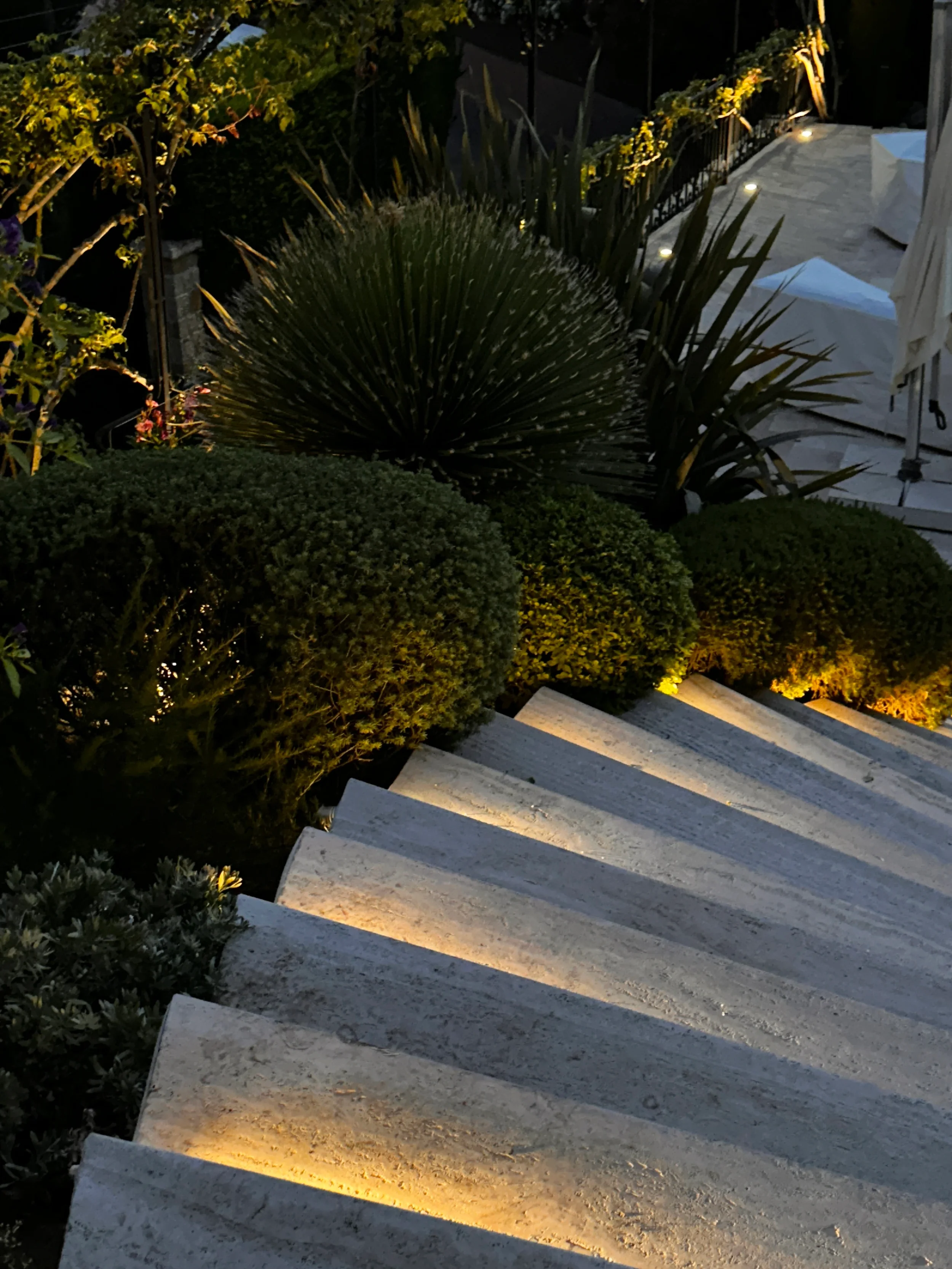
Before choosing fittings, consider what happens outside the house during a typical evening. A terrace used for dinner needs a different lighting arrangement from a pathway through the garden or a pool area used for swimming.
Dining tables, outdoor kitchens and covered seating areas need enough light for people to eat, prepare food and move around comfortably. Pathways, steps and changes in level need clear, consistent illumination. Elsewhere, a few carefully positioned lights may be enough to reveal the shape of a mature olive tree, the texture of a stone wall or the outline of the building.
It helps to divide the exterior into separate areas and give each one a clear purpose. This also makes it easier to control the lighting independently. You might want the terrace illuminated while the surrounding garden remains relatively dark, for example, or the pathway lights on without illuminating the entire façade.
Trying to light every part of a property equally can produce a flat result and consume more energy than necessary. A combination of functional lighting and softer accent lighting usually gives more flexibility.
Choosing the right type of exterior lighting
Different fittings serve different purposes, and their position often matters as much as their appearance.
Wall lights work well beside entrances, garage doors and covered terraces. They can provide useful illumination without taking up space in the garden. Check where the light falls before deciding on a fitting, particularly if it will sit close to a window, seating area or neighbouring property. An attractive wall light can still be uncomfortable if the lamp is visible at eye level.
Recessed ground lights can be used along pathways, beside steps or to highlight architectural features. They need careful positioning, as poorly placed fittings can shine directly into people's eyes. On a terrace, consider the view from a seated position as well as from standing height. Ground fittings also need to suit the surface they are installed in and the amount of water they may encounter.
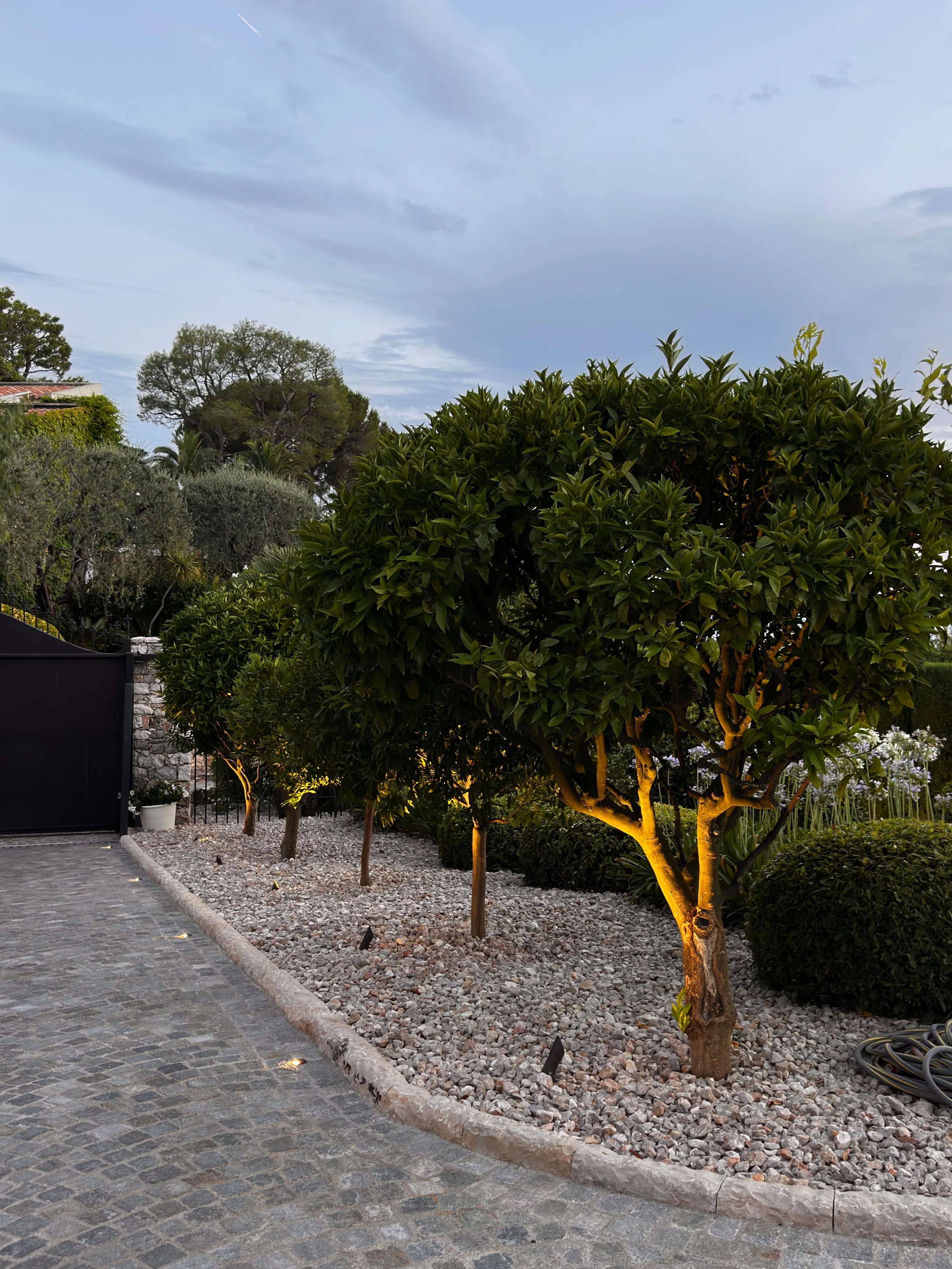
Spike lights and directional spotlights are useful for illuminating trees, planting and textured walls. Their direction can be adjusted, making them a practical choice where the garden may change over time. Avoid aiming them straight upwards without considering the beam, however, as much of the light can be wasted in the sky.
Bollard lights can help define paths and garden routes. Their effectiveness depends on the height, spacing and distribution of light. A row of bright bollards may create glare without providing particularly good visibility between fittings, so choose a design that directs light onto the walking surface.
Step lights can improve visibility on exterior staircases and changes in level. They should illuminate the tread and the next step clearly, without shining directly towards someone walking up or down the stairs.
Underwater and poolside lighting requires particular care. Lighting inside a swimming pool, around its perimeter and across the surrounding terrace involves different installation conditions. Equipment, positioning and electrical protection must be appropriate for the specific location and comply with the applicable French electrical requirements.
In most cases, a mixture of fitting types will be more useful than relying on one style throughout the property.
Colour temperature: why the shade of light matters
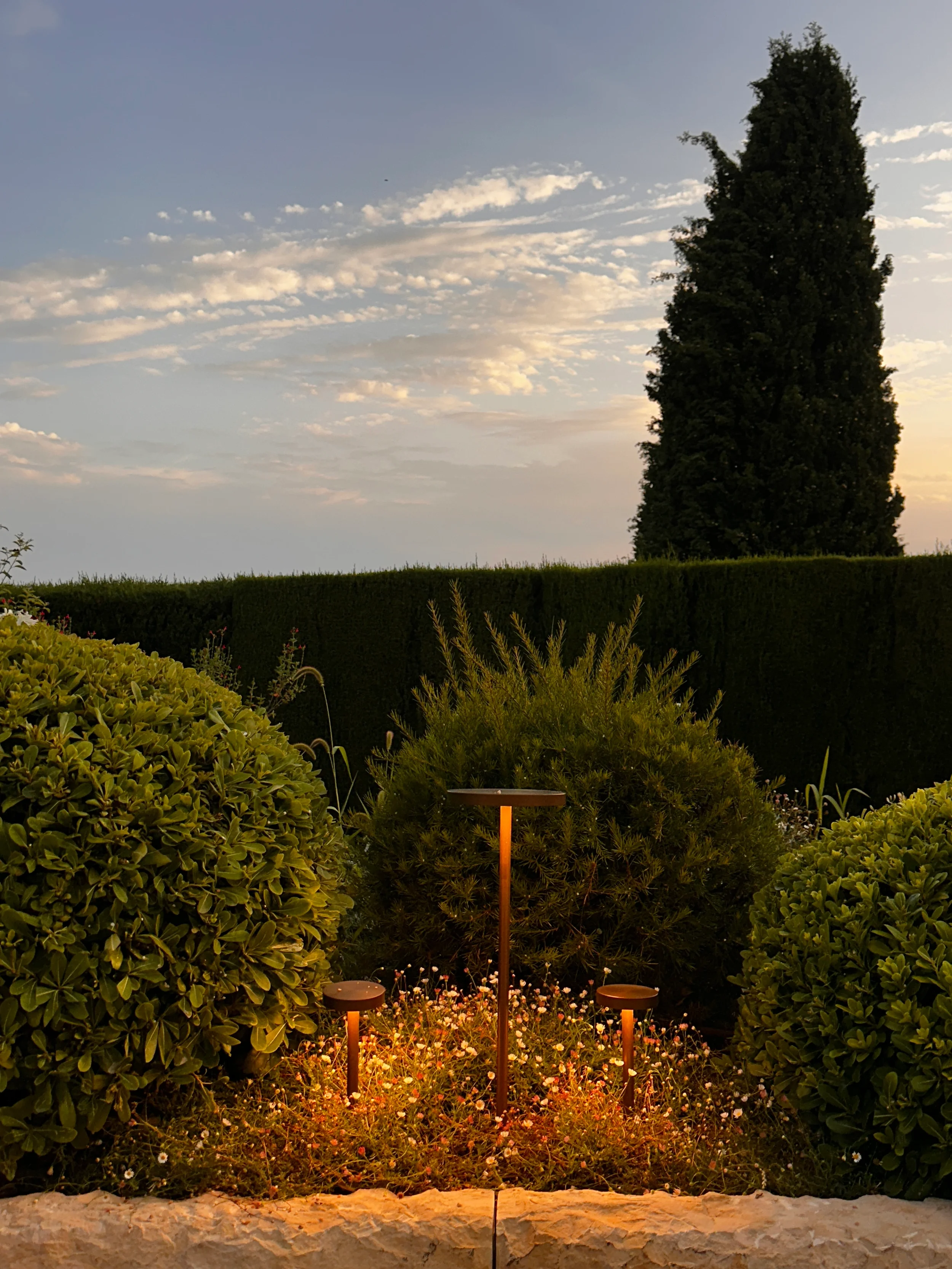
Colour temperature has a noticeable effect on how an exterior space looks at night. It is measured in kelvin (K), with lower figures producing warmer-looking light and higher figures producing a cooler, whiter appearance.
For many French Riviera villas, warm white lighting between approximately 2700 K and 3000 K is a sensible starting point. It tends to work well with limestone, rendered façades, timber, natural planting and traditional Mediterranean architecture. It can also make a terrace feel more comfortable in the evening.
Cooler lighting can be appropriate for certain contemporary buildings or specific functional areas, but using very white light throughout a garden can make the space feel harsh. It may also create a noticeable contrast between the exterior and the warm lighting inside the house.
Consistency is important. If adjacent lights have noticeably different colour temperatures, the garden can appear patchy, particularly where several fittings illuminate the same wall or planting bed.
It is worth checking the actual light output before committing to a large installation. A sample fitting switched on after dark can reveal more about its colour and appearance than a photograph in a catalogue.
Avoiding glare and overlighting
Glare is one of the most common problems with exterior lighting. It occurs when a light source is too bright or directly visible from the position where someone is standing or sitting. This can make it harder to see surrounding areas, rather than improving visibility.
The problem often becomes apparent on terraces. A spotlight aimed towards a tree may look effective when viewed from the garden, but if the beam is visible from the dining table, it can be distracting throughout the evening.
The answer is to consider the light from the user's point of view. Shielded fittings, recessed sources and carefully directed beams can help keep the light where it is needed. Before finalising positions, check the view from seating areas, bedroom windows, pathways and the approach to the entrance.
Brightness also needs to be considered in relation to the surroundings. A single powerful floodlight can make the rest of the garden appear unusually dark, while several lower-output fittings may provide more even visibility and a more comfortable atmosphere.
Avoid illuminating every tree, wall and architectural feature at once. Select a few elements that benefit from being highlighted and leave some areas in shadow. This creates depth and allows the eye to move naturally through the space.
It is equally important to avoid unnecessary light spilling into neighbouring properties or upwards into the night sky. Directional fittings, sensible output levels and timers can help reduce this.
Will exterior lights attract mosquitoes and other insects?
They can attract some insects, although the effect depends on the species, the light source and its wavelength. Moths and many other flying insects are often drawn to artificial lighting. Mosquitoes behave differently and rely heavily on cues such as carbon dioxide, body heat and human scent when locating people. Their response to light varies by species and conditions.
This distinction matters on the French Riviera, where outdoor dining and evening entertaining often coincide with warmer weather and increased insect activity. A brightly illuminated terrace may attract flying insects, but changing the lighting alone will not necessarily solve a mosquito problem.
There are several ways to reduce the impact.
Choose warmer light where practical. Warm-white, amber or yellow-toned sources generally attract fewer flying insects than many cool, blue-rich or ultraviolet sources. The precise effect varies, so this should be treated as a way to reduce attraction rather than eliminate it. Warm lighting also tends to suit outdoor residential spaces well.
Keep the light directed downwards. Shielded fittings and controlled beams help limit light escaping into the surrounding garden. This reduces unnecessary illumination and can lessen disruption to nocturnal wildlife. Avoid exposed bulbs and broad beams where a more contained light source would do the job.
Use lighting only when it is needed. Timers, dimmers and motion sensors can prevent lights from remaining on for hours when nobody is using the area. On a terrace, you may want the dining lights on throughout dinner but the pathway or security lights to switch off automatically afterwards.
Think about the position of the fittings. Where possible, avoid placing particularly bright lights immediately beside doors, open windows or the main dining table. A light positioned away from a seating area may be less disruptive, provided it still illuminates the intended space safely.
Deal with mosquito breeding sites separately. Mosquitoes lay eggs in standing water, so check plant saucers, blocked gutters, buckets, unused containers and other places where water can collect. Emptying or properly managing these sources is generally more useful for mosquito control than relying on a change of light bulb.
Ultraviolet bug zappers are not a good general solution for a residential garden. They can kill many non-target insects and are not a reliable way to control mosquitoes. If biting insects remain a persistent problem, appropriate mosquito-control measures may be needed alongside the lighting changes.
For most properties, the practical approach is to use warm, controlled lighting, avoid leaving unnecessary lights on overnight and manage standing water around the garden.
Materials and fittings for a coastal climate
The French Riviera's coastal environment can be demanding on exterior electrical equipment. Salt carried in the air can accelerate corrosion, while strong sunlight, heat and repeated exposure to water can affect finishes, seals and electrical connections.
A fitting that performs well in a sheltered inland garden may not be suitable for a villa directly exposed to sea spray. The distance from the sea, the property's orientation, the amount of shelter and the position of each fitting all influence the conditions it will face.
Material choice is therefore important. Marine-grade stainless steel, suitable brass and appropriately specified corrosion-resistant aluminium can all be considered, depending on the product and location. The quality of the finish, fixings and internal components matters too. A corrosion-resistant housing is of limited use if its screws or mounting brackets deteriorate quickly.
Pay attention to the manufacturer's environmental specifications rather than choosing on appearance alone. The IP rating indicates protection against the ingress of solids and water, but it does not indicate resistance to salt corrosion or guarantee that a fitting is suitable for every outdoor position.
The required protection will depend on whether the light is under a covered terrace, exposed to direct rain, installed at ground level or positioned in or near a swimming pool. Pool installations have additional requirements that must be assessed separately.
Regular maintenance is also worthwhile. Check fittings for corrosion, damaged seals, loose connections and signs of water ingress. Cleaning salt deposits from exposed fittings with fresh water, where permitted by the manufacturer's instructions, can help limit deterioration. Do not open or work on electrical fittings while they are energised.
Planning for maintenance from the beginning
Exterior lighting is often installed at the end of a renovation, when the landscaping is nearly finished and there is pressure to complete the project. However, cable routes, power supplies and control systems are easier to plan before paving, planting and other finishes are in place.
This is particularly relevant for villas with extensive gardens, retaining walls, swimming pools or several outdoor living areas. Installing cables after the landscaping is complete can mean disturbing finished surfaces or working around established planting.
Consider how accessible each fitting will be for cleaning, adjustment and eventual replacement. Ground lights should be selected with their installation surface and drainage conditions in mind. Lights hidden in dense planting may look discreet initially but become difficult to reach as the garden grows.
It is also worth thinking ahead about future changes. If you expect to add an outdoor kitchen, pergola or new seating area, discuss the likely requirements with the electrician before the main installation is completed.
LED lighting is widely used for exterior installations because of its energy efficiency and long operating life. However, the overall quality of the fitting, its operating conditions and the availability of replacement components all influence how easy it will be to maintain over time.
Controls, sensors and smart lighting
Separate controls make an exterior lighting installation more convenient to use. Rather than switching on every outdoor light together, you can create different circuits for entrances, pathways, terraces, planting and security.
Timers are useful for lights that should operate at predictable times. Motion sensors can work well at entrances and side passages, where light is needed when someone approaches. Sensitivity, detection range and the length of time the light remains on should be adjusted to suit the location and avoid unnecessary activation.
Dimmers provide another option for terraces and covered outdoor living spaces. A higher light level may be useful when preparing food or clearing a table, while a lower setting can be more comfortable during a late evening outside.
Smart-home systems can bring these functions together, allowing exterior lighting to be controlled through programmed scenes or schedules. For example, a property might have an arrival setting that illuminates the entrance and pathway, an entertaining setting for the terrace, and a reduced night-time setting for essential access routes.
The control system should be chosen to suit the property and the way it will be used. A straightforward arrangement of switches and timers may be sufficient for a smaller villa, while a larger property with extensive outdoor areas may benefit from a more integrated solution.
A final consideration before installation
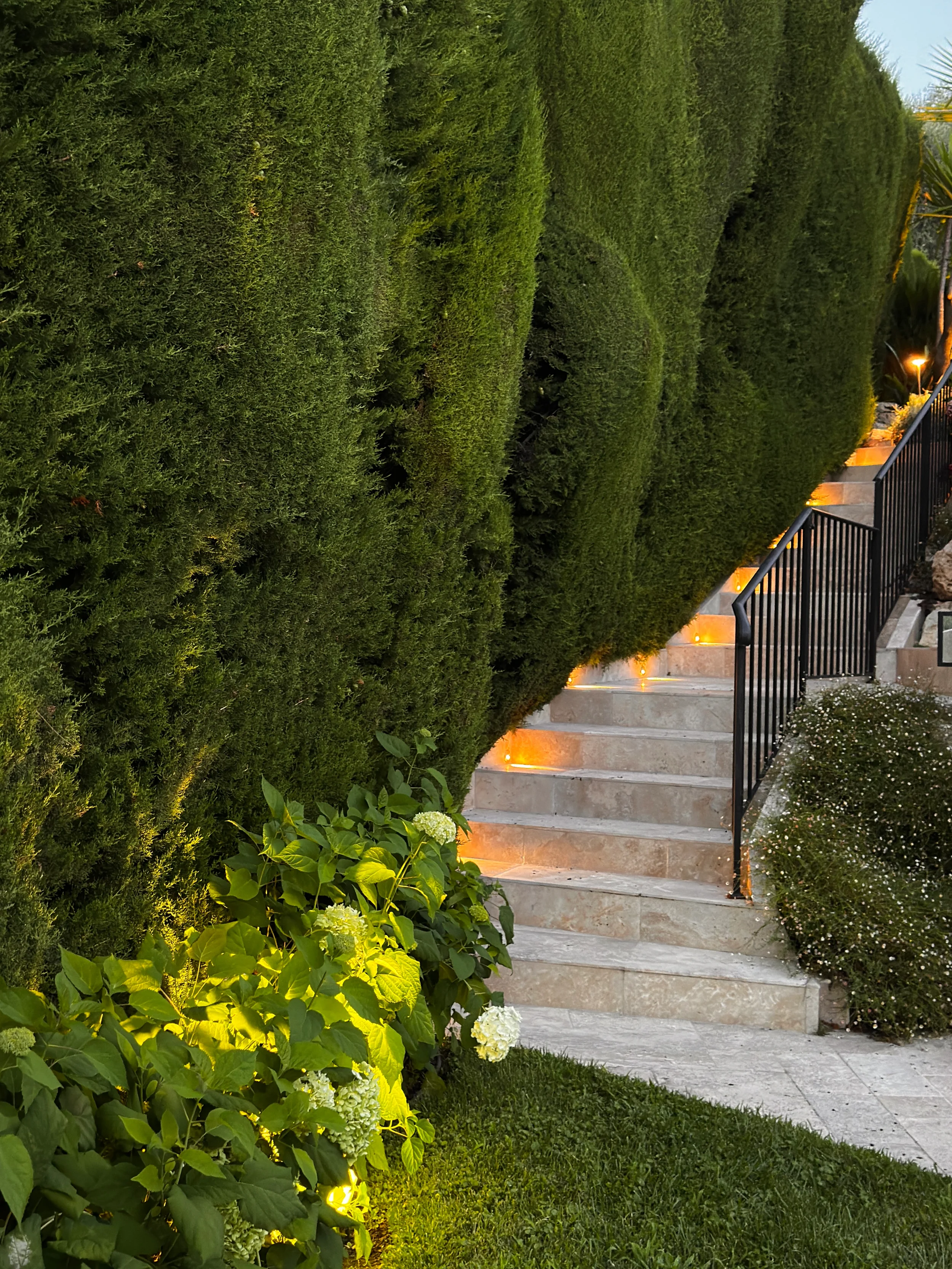
Exterior lighting works best when it is considered alongside the architecture, garden design and electrical installation. The position of trees, the height of boundary walls, the layout of pathways and the way people use the terrace all influence where light is needed.
For a renovation, it is worth reviewing the proposed lighting after dark before committing to the final positions. Temporary lights can help reveal whether a fitting is too bright, whether a tree is being illuminated from the wrong angle or whether a pathway needs more even coverage.
An electrician can assess the wiring, circuit protection, equipment suitability and controls, while a landscape lighting designer can help develop the overall arrangement where the project calls for it. On larger properties, coordinating these decisions with the landscape architect or garden designer can prevent expensive changes later.
For villas across Nice, Monaco and the wider French Riviera, the aim is to create an exterior lighting scheme that remains useful, comfortable and reliable through the seasons. Careful positioning, suitable materials, sensible controls and regular maintenance will make a significant difference to how the installation performs over time.
Planning exterior lighting for a villa or renovation on the French Riviera? JL Electric provides electrical services across Nice, Monaco and the wider Côte d’Azur, including exterior lighting installations and electrical work for residential and commercial properties. Get in touch to discuss the requirements of your project.